Current Freight Rates
Price data updating. Contact us for current rates.
Trade Terms Explained — Who Pays for What EXW, FOB, CIF, DDP and seven more — see which costs sit with us and which sit with you
The rate above is quoted on one specific trade term. Change the term and you change how much of the journey to United States is already inside the price. The table below maps the eleven common Incoterms® against the twelve cost stages of a door-to-door shipment, so you can see exactly where our responsibility ends and yours begins.
- Seller — Cost and arrangement sit with the seller / shipper.
- Buyer — Cost and arrangement sit with the buyer / consignee.
- Negotiable — Not fixed by the rule — agree it in the contract.
| Term | 1 Loading on truck | 2 Export customs declaration | 3 Carriage to port of export | 4 Unloading at port of export | 5 Loading on vessel / aircraft | 6 Main carriage | 7 Cargo insurance | 8 Unloading at port of import | 9 Loading on truck at import | 10 Carriage to destination | 11 Import customs clearance | 12 Import duties & taxes |
|---|---|---|---|---|---|---|---|---|---|---|---|---|
| EXW Ex Works | Buyer Buyer — Loading on truck | Buyer Buyer — Export customs declaration | Buyer Buyer — Carriage to port of export | Buyer Buyer — Unloading at port of export | Buyer Buyer — Loading on vessel / aircraft | Buyer Buyer — Main carriage | Buyer Buyer — Cargo insurance | Buyer Buyer — Unloading at port of import | Buyer Buyer — Loading on truck at import | Buyer Buyer — Carriage to destination | Buyer Buyer — Import customs clearance | Buyer Buyer — Import duties & taxes |
| FCA Free Carrier | Seller Seller — Loading on truck | Seller Seller — Export customs declaration | Buyer Buyer — Carriage to port of export | Buyer Buyer — Unloading at port of export | Buyer Buyer — Loading on vessel / aircraft | Buyer Buyer — Main carriage | Buyer Buyer — Cargo insurance | Buyer Buyer — Unloading at port of import | Buyer Buyer — Loading on truck at import | Buyer Buyer — Carriage to destination | Buyer Buyer — Import customs clearance | Buyer Buyer — Import duties & taxes |
| FAS Free Alongside Ship | Seller Seller — Loading on truck | Seller Seller — Export customs declaration | Seller Seller — Carriage to port of export | Seller Seller — Unloading at port of export | Buyer Buyer — Loading on vessel / aircraft | Buyer Buyer — Main carriage | Buyer Buyer — Cargo insurance | Buyer Buyer — Unloading at port of import | Buyer Buyer — Loading on truck at import | Buyer Buyer — Carriage to destination | Buyer Buyer — Import customs clearance | Buyer Buyer — Import duties & taxes |
| FOB Free On Board | Seller Seller — Loading on truck | Seller Seller — Export customs declaration | Seller Seller — Carriage to port of export | Seller Seller — Unloading at port of export | Seller Seller — Loading on vessel / aircraft | Buyer Buyer — Main carriage | Buyer Buyer — Cargo insurance | Buyer Buyer — Unloading at port of import | Buyer Buyer — Loading on truck at import | Buyer Buyer — Carriage to destination | Buyer Buyer — Import customs clearance | Buyer Buyer — Import duties & taxes |
| CFR Cost and Freight | Seller Seller — Loading on truck | Seller Seller — Export customs declaration | Seller Seller — Carriage to port of export | Seller Seller — Unloading at port of export | Seller Seller — Loading on vessel / aircraft | Seller Seller — Main carriage | Buyer Buyer — Cargo insurance | Buyer Buyer — Unloading at port of import | Buyer Buyer — Loading on truck at import | Buyer Buyer — Carriage to destination | Buyer Buyer — Import customs clearance | Buyer Buyer — Import duties & taxes |
| CIF Cost, Insurance and Freight | Seller Seller — Loading on truck | Seller Seller — Export customs declaration | Seller Seller — Carriage to port of export | Seller Seller — Unloading at port of export | Seller Seller — Loading on vessel / aircraft | Seller Seller — Main carriage | Seller Seller — Cargo insurance | Buyer Buyer — Unloading at port of import | Buyer Buyer — Loading on truck at import | Buyer Buyer — Carriage to destination | Buyer Buyer — Import customs clearance | Buyer Buyer — Import duties & taxes |
| CPT Carriage Paid To | Seller Seller — Loading on truck | Seller Seller — Export customs declaration | Seller Seller — Carriage to port of export | Seller Seller — Unloading at port of export | Seller Seller — Loading on vessel / aircraft | Seller Seller — Main carriage | Negotiable Negotiable — Cargo insurance | Seller Seller — Unloading at port of import | Seller Seller — Loading on truck at import | Seller Seller — Carriage to destination | Buyer Buyer — Import customs clearance | Buyer Buyer — Import duties & taxes |
| CIP Carriage and Insurance Paid | Seller Seller — Loading on truck | Seller Seller — Export customs declaration | Seller Seller — Carriage to port of export | Seller Seller — Unloading at port of export | Seller Seller — Loading on vessel / aircraft | Seller Seller — Main carriage | Seller Seller — Cargo insurance | Seller Seller — Unloading at port of import | Seller Seller — Loading on truck at import | Seller Seller — Carriage to destination | Buyer Buyer — Import customs clearance | Buyer Buyer — Import duties & taxes |
| DAT Delivered At Terminal (DPU) | Seller Seller — Loading on truck | Seller Seller — Export customs declaration | Seller Seller — Carriage to port of export | Seller Seller — Unloading at port of export | Seller Seller — Loading on vessel / aircraft | Seller Seller — Main carriage | Negotiable Negotiable — Cargo insurance | Seller Seller — Unloading at port of import | Buyer Buyer — Loading on truck at import | Buyer Buyer — Carriage to destination | Buyer Buyer — Import customs clearance | Buyer Buyer — Import duties & taxes |
| DAP Delivered At Place | Seller Seller — Loading on truck | Seller Seller — Export customs declaration | Seller Seller — Carriage to port of export | Seller Seller — Unloading at port of export | Seller Seller — Loading on vessel / aircraft | Seller Seller — Main carriage | Negotiable Negotiable — Cargo insurance | Seller Seller — Unloading at port of import | Seller Seller — Loading on truck at import | Seller Seller — Carriage to destination | Buyer Buyer — Import customs clearance | Buyer Buyer — Import duties & taxes |
| DDP Delivered Duty Paid | Seller Seller — Loading on truck | Seller Seller — Export customs declaration | Seller Seller — Carriage to port of export | Seller Seller — Unloading at port of export | Seller Seller — Loading on vessel / aircraft | Seller Seller — Main carriage | Negotiable Negotiable — Cargo insurance | Seller Seller — Unloading at port of import | Seller Seller — Loading on truck at import | Seller Seller — Carriage to destination | Seller Seller — Import customs clearance | Seller Seller — Import duties & taxes |
EXW Ex Works
Buyer takes over at the seller's door and carries every cost from there. Lowest quoted price, highest buyer workload.
FCA Free Carrier
Seller clears the goods for export and hands them to the carrier the buyer nominated.
FAS Free Alongside Ship
Sea and inland waterway only. Seller delivers alongside the vessel; loading is on the buyer.
FOB Free On Board
Sea and inland waterway only. Risk passes once the goods are on board. The most common buying term.
CFR Cost and Freight
Seller pays the main carriage but carries no insurance obligation; risk still passes on loading.
CIF Cost, Insurance and Freight
As CFR, plus the seller must buy and pay for cargo insurance (minimum cover unless you agree more).
CPT Carriage Paid To
Any mode. Seller pays carriage through to the named destination; insurance is not obligatory.
CIP Carriage and Insurance Paid
As CPT, plus the seller must insure the cargo through to the named destination.
DAT Delivered At Terminal (DPU)
Seller delivers unloaded at the named terminal. Renamed DPU (Delivered at Place Unloaded) in Incoterms® 2020.
DAP Delivered At Place
Seller delivers to your address ready for unloading; import clearance and duty stay with the buyer.
DDP Delivered Duty Paid
Seller carries everything through to your door, duty and tax included. Highest quoted price, least buyer workload.
Two things worth flagging. Under CIF and CIP the seller is obliged to buy cargo insurance and pay the premium; under every other term insurance is optional, and we recommend buyers arrange their own cover so a loss or damage in transit is recoverable. And this table is a working summary for planning purposes — the binding definitions are the ones published by the International Chamber of Commerce in the Incoterms® rules, so confirm the exact term wording in your sales contract before you ship.
Service Details
Ningbo → New York Container Shipping
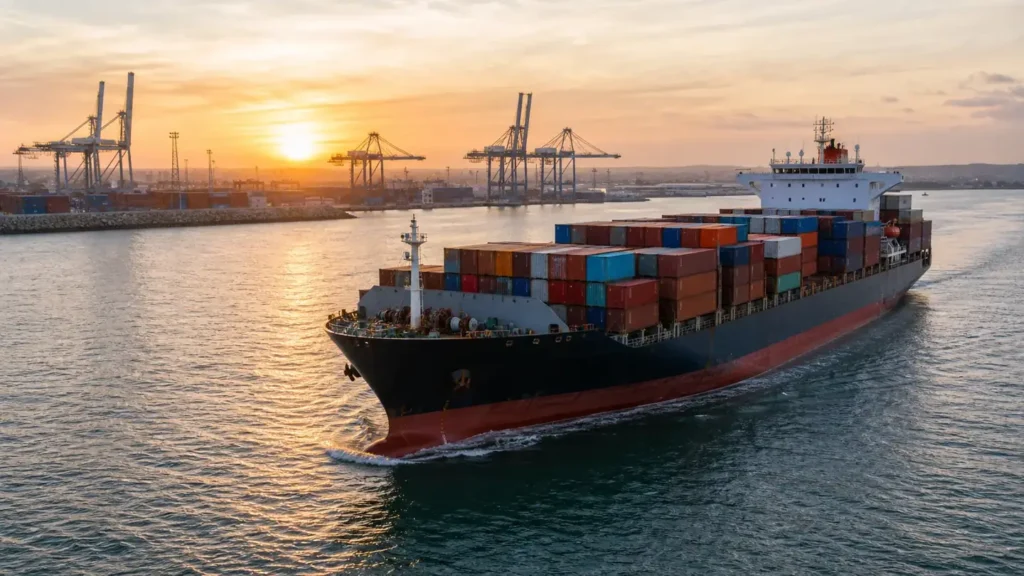
Ningbo to New York container shipping, priced per box rather than per CBM. This is the lane to book when the cargo fills a container or when it should not share one: machinery, stone, steel, building materials and project pieces all move better as FCL because nothing else is loaded around them. Plan on 16–30 days port to port port to port.
Port-to-port means exactly that: the rate ends at the New York terminal gate. Typical dwell at destination runs 2–5 days before the box is available for collection, and that window sits outside the transit figure above. Origin haulage, export declaration, destination clearance, duty and delivery beyond the terminal are all quoted separately, so ask for a door figure if that is what you are comparing against.
Rate by Container Type
- 20GP — quoted on request for the current sailing
- 40HQ — quoted on request for the current sailing
Every consignment on this service is measured as well as weighed. Volumetric weight is L×W×H in centimetres divided by 6000 — one cubic metre counted as roughly 166.7 kg — and whichever figure is higher is the one charged. Dense cargo pays on its weight; light bulky cargo pays on its volume, and repacking to raise density is often the cheapest saving available on a United States shipment.
Typical cargo on this route: electrical cabinets (HS 85 / 8541), where clearance turns on cE and IEC conformity, and a check that voltage and grid code match the destination, conveyor belts (HS 39 / 40) and building materials (HS 68 / 69 / 70 / 44). If yours is on that list the commodity page is worth two minutes — it covers how the goods should leave the factory, how they should sit in the container, and the failure mode we see most often on this kind of freight.
To see this tariff against a real consignment rather than a rate card, the 100 KG, 300 KG and 500 KG pages run it at a fixed weight and show the landed total, including the point where stepping up a bracket lowers your cost per kilo. They are the fastest way to check whether consolidating two orders into one is worth the wait.
We move sea freight cargo for United States through Los Angeles/Long Beach, New York/Newark and Savannah. The quoted rate covers the ocean leg to whichever of those the vessel calls at; the difference between them shows up in the trucking cost beyond the quay, which is why it pays to name the delivery city when you ask for a quote rather than just the country.
The table above prices the lane, but most buyers arrive with a consignment already in mind. If yours has a known weight, the 100 KG, 300 KG and 500 KG breakdowns run this tariff against a fixed shipment so you see a landed number rather than a rate per kilo, and the China to United States Sea Freight Cost page sets every channel we run on this lane side by side. For the wider picture including documentation and duty, start from shipping from China to United States.

Track your shipment
Enter your tracking number below
Powered by 17TRACK — supports 2,000+ carriers worldwide
Track your container to United States
Ocean cargo is tracked by container number, not by a parcel barcode. Enter yours below: we check it is a valid number, identify the line that owns it, and take you straight to that line's tracking page for this ocean service.
A container number is four letters and seven digits, for example MSKU6090510. The last digit is a check digit, so a typo can be caught here rather than by an empty result on the carrier's site. We validate it in your browser — the number is not sent to us or to anyone else.
Additional Information
Scope, Exclusions and What to Check Before Booking
This is a port-to-port FCL rate for Ningbo to New York. It covers ocean freight for one container and stops at the New York terminal gate. Everything either side of that — trucking to Ningbo, customs at both ends, duty and tax for United States, inland delivery — is quoted on request rather than bundled, which keeps the freight number comparable between carriers.
- Priced per box in USD for 20GP and 40HQ, not per KG or per CBM — utilization is yours to optimize
- Transit 16–30 days port to port port to port on Ningbo to New York, subject to the sailing booked
- Heavy and out-of-gauge cargo is core traffic here: machinery, steel, stone, building materials, project pieces
- Cut-off and free time attach to the specific sailing; demurrage begins the day free time expires
- Reefer, dangerous goods and out-of-gauge are priced case by case rather than from the card
- Clearance at destination is handled by U.S. Customs and Border Protection (CBP); the consignee must be registered to import
- Destination conformity for United States: FCC for radio devices; FDA Prior Notice for food/supplements
The most expensive mistake on a Ningbo to New York booking is not the freight rate, it is free time. Demurrage and detention start counting at the New York terminal whether or not your consignee is ready, and on a bad week they can exceed the ocean freight itself. Confirm how many free days the booking carries before you fix a collection date.
Before you book, confirm two things with your consignee: that they are registered to import into United States, and that whoever is named as importer of record accepts the duty liability. Those are dull questions and they are also the two that most often surface only after the cargo has already sailed.
Where these numbers come from
Treat the landed-cost numbers here as a planning baseline. U.S. Customs and Border Protection sets the rate that actually gets charged, assessed against your HS classification at the moment of clearance, so their own guidance is worth reading before a large order.
If you want to sanity-check a duty figure yourself, start from the heading rather than the product name — the WCO Harmonized System is the underlying nomenclature, and the WTO Tariff & Trade Data portal holds the applied rates by country pair.
For ocean cargo, restricted commodities move under the IMO's IMDG Code, and the container has to be declared and stowed accordingly. Batteries, flammables and corrosives all have a compliant ocean path; what causes rolled bookings is finding out about them after the container is packed.
On the origin side, export declaration and any commodity inspection requirement fall under China Customs (GACC); we handle that filing as part of the service, but the requirement is theirs, not ours.
China to United States — Shipping Reference Data
| Main sea gateways | Los Angeles/Long Beach, New York/Newark, Savannah |
|---|---|
| Destination customs authority | U.S. Customs and Border Protection (CBP) |
| De-minimis / duty-free threshold | USD 800 |
| Import tax & duty regime | No federal VAT; duty 0–6.5% by HTS code |
| Local currency | USD |
| Typical clearance / dwell time | 2–5 days |
| Peak / busy season | Aug–Oct |
| Conformity & certification | FCC for radio devices; FDA Prior Notice for food/supplements |
Thresholds and duty bands are buyer-planning references, not formal customs rulings — confirm the exact HS-code rate for your goods before shipping.
Free 3D Loading Tools for This Sea Route
This page covers a Sea freight service from China to United States. Use the matching tool below to plan your cargo before requesting a quote.
3D Container Loading Planner
Wondering whether your cargo fills a 20GP or needs a 40HQ for this United States route? The 3D container planner simulates cartons, crates, pallets, and even mixed box sizes in one container.
Open Container Planner →United States Sea Freight Checklist
- Confirm whether your United States rate is per CBM or per container before comparing quotes.
- Reserve loading space 5-7 days before the sailing cut-off for this route during peak season.
- Ask whether the quote includes destination port charges in United States or only ocean freight.
- Photograph the container number, seal, and loading process for insurance evidence.
Frequently Asked Questions
How long does Sea FCL Port-to-Port from China to United States take?
Sea freight on this route runs about 25–45 calendar days door-to-door, plus roughly 2–5 days of clearance/dwell once it reaches the gateway. All times include customs clearance under DDP terms.
What duties and taxes apply when importing into United States?
Clearance is handled by U.S. Customs and Border Protection (CBP). The regime is: No federal VAT; duty 0–6.5% by HTS code, with a de-minimis position of USD 800. Under DDP these are pre-paid, so nothing is collected on arrival.
What certification is needed to import into United States?
For regulated goods, plan for: FCC for radio devices; FDA Prior Notice for food/supplements. Missing conformity paperwork is the most common clearance hold with U.S. Customs and Border Protection (CBP), so confirm requirements for your HS code before shipping.
What does DDP shipping to United States include on this route?
DDP means we quote the freight, the customs entry with U.S. Customs and Border Protection (CBP) and last-mile delivery in United States together, so you settle once. The duty and tax portion depends on your product's HS code, declared value and the exchange rate at entry, so it is confirmed against your actual goods — the figures on this page are indicative and can move either way.
Which ports or airports does this route use into United States?
Sea cargo to United States clears through Los Angeles/Long Beach, New York/Newark, Savannah; air freight clears via LAX, ORD (Chicago), JFK. We route through whichever gateway gives the fastest onward delivery to your address and build it into the DDP price.
How is the shipping cost on this route calculated?
We compare actual gross weight against volumetric weight (L×W×H ÷ 6000, so one cubic metre counts as about 166.7 kg) and charge whichever is greater, rounded up to the next kilogram, then apply the per-KG rate shown in the table above. A 300 kg consignment measuring out to only 200 kg volumetric is still charged on the 300 kg.
Shipping United States cargo by industry
This rate is for the lane. What decides whether the cargo arrives intact is the commodity — how it prices, how it must be packed and loaded, and which compliance step holds it at the border. These guides cover that per industry.
- Technical Textiles Textiles, Apparel, Footwear & Leather
- Outdoor Products Toys, Sports, Outdoor & Leisure
- Fasteners Metal Products & Industrial Components
- Electric Motors General Machinery & Industrial Equipment
- Wire & Cable New Energy, Power & Electrical
- Wall Panels Building Materials & Construction Products
- Injection Molded Parts Plastics, Rubber & Packaging
- Furniture Furniture & Home Products
- Home Storage Products Furniture & Home Products
- Exhibition Display Equipment Retail, Display & Commercial Fixtures
- Aluminum Coils Steel & Metal Materials
- Pipe Fittings Metal Products & Industrial Components